As part of my role at UC San Diego, I am tasked with researching cutting edge developments in sound capture and diffusion systems. One of the areas I enjoy exploring the most involves the ways the capture and playback systems are able to (re)create experiences of immersion and spatiality, and so when I was invited to give a guest lecture / research presentation at Bread and Salt back on January 16th (Project Blank), I knew immediately that I would like to share my findings on two wildly different approaches to spatialized sound.
In this research presentation I set myself the goal of clearly demonstrating the difference between standardised playback models (in this case octophonic) that preference phantom imaging and make claims to a certain verisimilitude, and those designed to work in sympathy/resonance with a playback environment (using the Acousmonium approach developed at GRM, as my ideal) that claim a phenomenal impact to the sound itself rather than the image of space it creates.
Through playing back examples of sound in both formats, I concluded that standardised mutlichannel arrays (by dint of their standardization) aim to erase or negate acoustic signatures and thus require playback space to be neutralized or erased, while phenomenological approaches attempt to emphasise the materiality of a given space at the expense of the clear phonographic reproduction of an auditory scene.
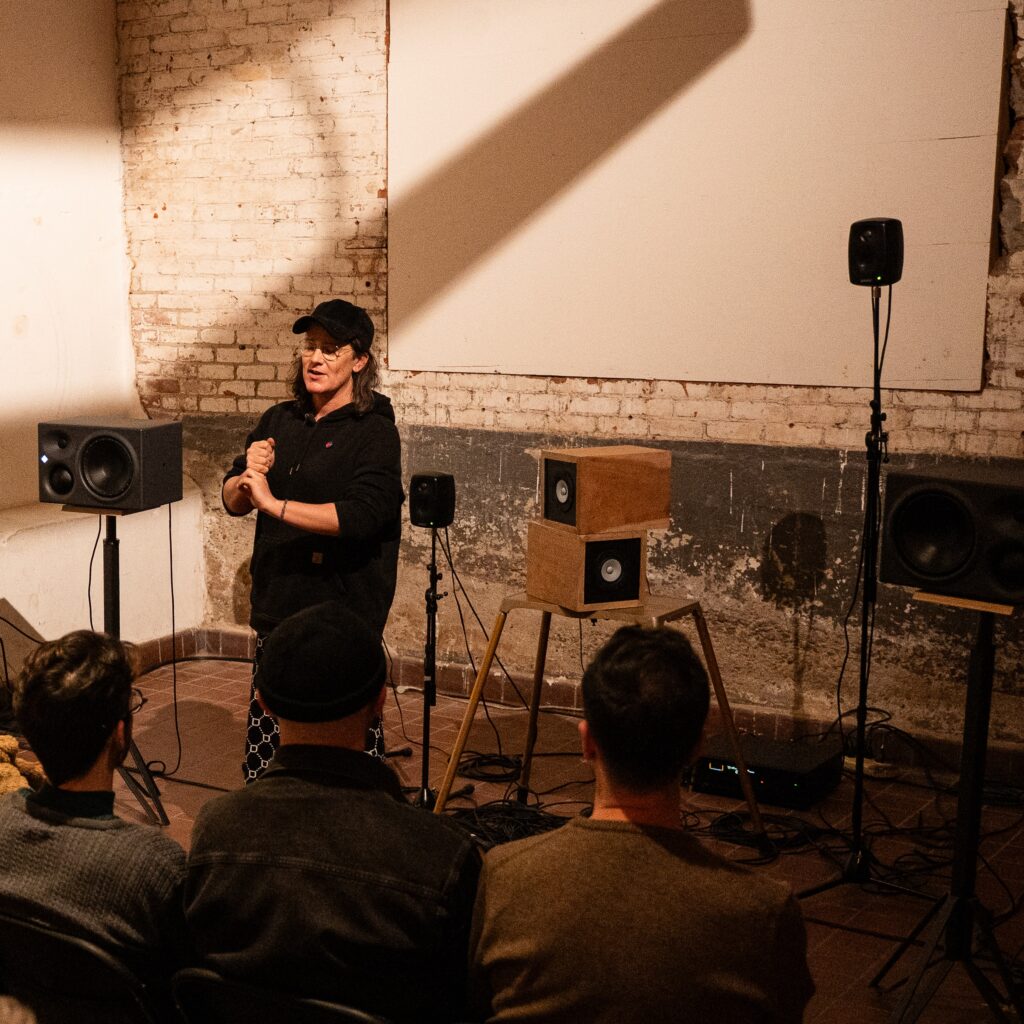
Talking about the acousmonium, in front of a partial ad-hoc acousmonium of 18 channels. Speakers chosen and placed in resonance with the space, though of course installation of a full acousmonium was impractical and unnecessary for a guest lecture!
Leave a Reply